
Some journeys are more than travel. They are pilgrimages of the heart. For Rodney “Rod” Michaelson, a resident of Walnut Creek, California, his first trip to England was just that—a quest for connection, understanding, and a chance to walk in the footsteps of a father he lost far too soon.
Rod was only 12 years old when his father, James Michaelson, passed away in 1966. James had served as a B-24 Liberator Ball Turret Gunner with the 753rd Squadron, 458th Bomb Group, flying from Horsham St Faith during WWII. Like so many veterans, his battle didn’t end when the war did. He carried the invisible wounds of trauma home with him, and eventually, those wounds took their toll.
Now, nearly eight decades later, Rod travelled to Norwich—the very airfield where his father’s aircraft, A Dog’s Life, once stood ready for missions over Europe. For Rod, this was not just history—it was family.
Arriving on Thursday, Rod stepped straight into living history at the Silver Wings Exhibition at The Forum, Norwich. Surrounded by wartime stories, photographs, and those who had helped bring the exhibition to life, he began to feel the threads of connection weaving together.
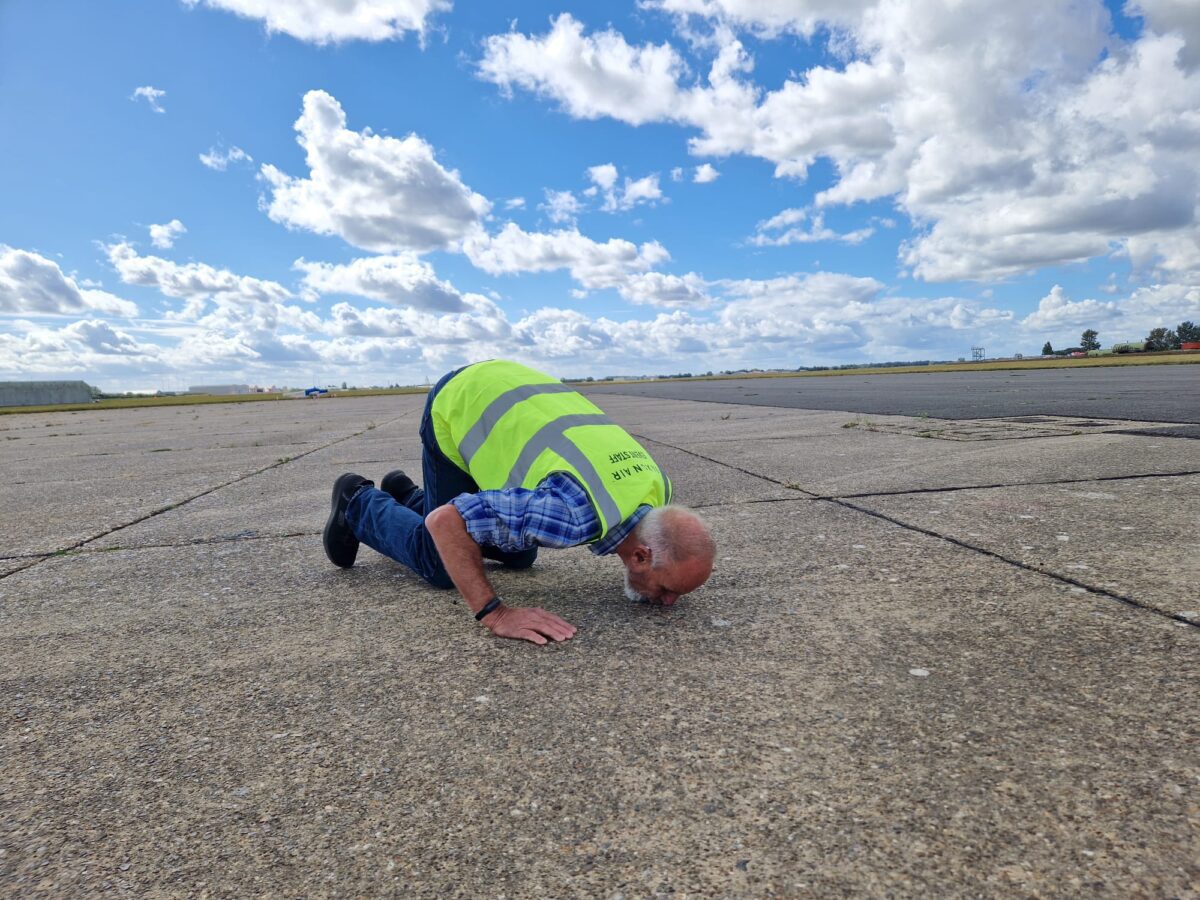
Friday morning brought one of the most moving moments of the trip. With the help of SaxonAir and the New Farm Aviation Museum, Rod stood on the very hardstand where A Dog’s Life once rested. Beneath his feet lay a faint but undeniable mark—a B-24 tyre imprint preserved in the concrete since 1944.
Time seemed to dissolve. For a moment, Rod stood not just in a place, but in his father’s past.
The journey continued through the Liberator Café, the City of Norwich Aviation Museum, and later to Old Catton, where A Dog’s Life tragically crashed after James had returned home. At Bungay, Rod explored Site Four of the 446th Bomb Group, a wartime communal site now entrusted to the USAAF Heritage Trust to preserve as a living museum.
The weekend was rich with encounters—wartime vehicles, reenactors, and personal stories at The Forum’s 1940s street party. Rod climbed into the only remaining USAAF Wrecker in the UK, swapped stories with jeep owners, and immersed himself in the daily lives of those who once supported the air war from the ground.
At the New Farm Aviation Museum, Rod received a gift unlike any other: a keyring made from Plexiglass recovered from his father’s B-24. It was a tangible piece of history, a fragment of his father’s story he could take home in his pocket.
And then, the skies opened. SaxonAir arranged a 20-minute flight over Norwich, giving Rod a breathtaking view of the landscape his father once flew over daily. It was, in many ways, a symbolic handover—from father to son, past to present, memory to legacy.
The journey ended, appropriately, in a pub. At The Bull in Hellesdon, once a favourite haunt of 458th servicemen, Rod enjoyed a Sunday roast, raised a glass, and honoured his father’s memory.
Four days. A lifetime of meaning. Rod returned to America with answers, with memories, and with a deeper connection to a man he lost as a boy—but rediscovered as a son.