
3 November 2026
Winter has a way of ending the day early. By mid-December the sun is gone before 4pm, and the commute, the client dinner and the evening match all happen in the dark.
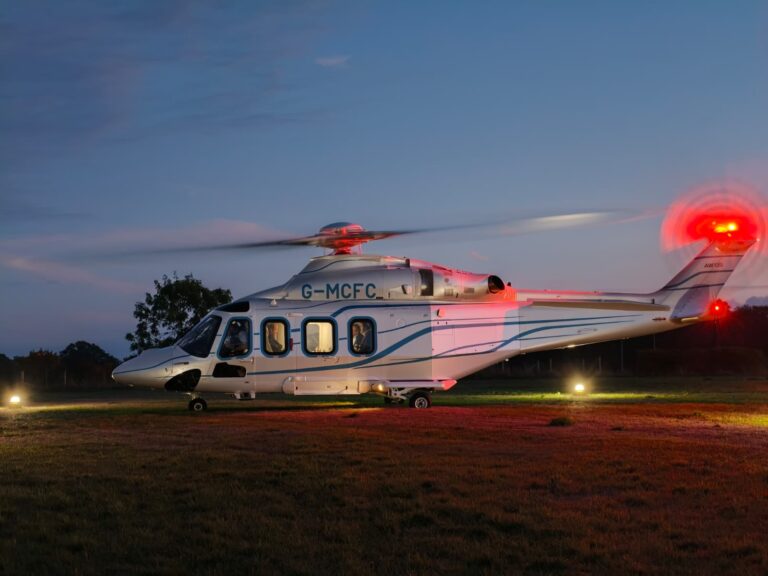
For our rotary team, that’s when things get interesting. A helicopter after dark is a flying lighthouse, and every light on it has a job to do.
Position lights: the aircraft’s “I’m here” signal
Like a ship, a helicopter carries coloured navigation lights so other aircraft can tell which way it’s facing. There’s a red light on the left (port) side, a green light on the right (starboard) side, and a white light at the tail. See red and green together and it’s heading towards you. See only white and it’s flying away. Pilots have a rhyme for remembering the colours: “red port wine left.”
Anti-collision lights: the attention-grabbers
These are the flashing ones. A red rotating beacon and/or white strobe lights are designed to be noticed from a distance, cutting through a dark sky so that other pilots can spot the aircraft early. On a clear winter night, they’re visible for miles.
Landing lights and searchlights: the headlights
The landing light does what it sounds like. It lights up the approach and the touchdown area, helping the pilot judge height, closing speed and the condition of the surface. On many helicopters the light can be angled or retracted, so the pilot can aim it where it’s needed and stow it when it’s not. LED versions are increasingly common, because they’re brighter, longer-lasting and use less power.
Some aircraft also have a separate, steerable searchlight, which is much more powerful. It’s the kind you’ll have seen on police and air ambulance helicopters, and it’s useful for checking an unfamiliar landing site.
A bright light isn’t always helpful, though. In rain, mist or falling snow, a landing light can bounce back off the particles and create glare, a bit like driving with your full beams on in fog. Pilots learn to manage this, sometimes by adjusting the light angle or intensity.
Inside the cockpit: lights that go dim
The human eye takes a while to adjust to the dark, and it can take up to around 30 minutes to reach full night vision. A bright cockpit would undo all that work, so instrument and cockpit lighting is dimmable, letting the crew read their instruments without losing their view of the outside world. Where operators use night vision goggles, the cockpit lighting also has to be specially designed to be compatible with them.
The landing site: where the preparation really begins
Aircraft lights are only half the story, and the preparation for a night landing starts long before the rotors turn. It begins in the office, with an initial survey and suitability assessment of the site. Then we attend in person to confirm it’s suitable, measure and survey any obstacles, and liaise with the flight crew to agree the lighting plan.
On the night, the site typically relies on perimeter lighting to define the landing area, an illuminated windsock so the pilot can see the wind direction at a glance, and sometimes floodlighting to help with the final approach. The exact requirements depend on the site and the regulator’s guidance, which is why every night landing is planned carefully in advance.
Why the dark is trickier than it looks
With fewer visual cues, depth perception is reduced at night. Over dark, unlit ground a pilot has less to judge distance and height by, which is why a well-lit, well-briefed landing site makes such a difference. Add winter weather such as low cloud, mist or snow, and preparation matters even more.
And the reward? The view
Crisp, clear winter evenings from the air are spectacular. Towns glow, roads trace ribbons of light across the countryside, and the whole region looks completely different. Passengers often tell us the view is the best part of the trip.
Plan your winter flying now
December diaries fill up quickly. If you’re planning corporate travel, private transfers or a special evening out, get in touch early so we can help plan your journey and secure your preferred dates.
Speak to the Saxon Air team about your next helicopter charter: heliops@saxonair.com.
Categories: Aviation, Corporate Helicopter Charter